Monday, October 3, 2011

Miss Saison


This ale melds Old World ingredients in a new school style. French malted barley, English oats and Belgian yeast create honey & black pepper flavors. Lively Slovenian hops provide the floral, apricot and peach notes-Like the Euro, a collaboration of European countries. Let's just hope this one's a bit more successful!
Grist:
8.75 lbs Franco-Belges Pilsner Malt
0.63 lb. Simsons Golden Naked Oats
0.63 lbs. Weyermann Acidulated Malt
0.63 lbs. Belgian Aromatic Malt
Hops:
0.25 oz Styrian Goldings (First Wort Hop, add to wort as it drains from mash
tun)
0.25 oz Columbus (60 min)
1.75 oz Styrian Goldings (0 min)

Yeast:
WLP550-Belgian Ale
Mash schedule:
Sacch’ Rest: 148° F for 60 minutes
4 gallons 162 degree water
Mashout: 168° F for 10 minutes-1 gallon
Sparge 3.25 gallons 170 degree water
Actual OG 1.050
Ferment at 68 for 3 days, then slowly raise the ambient temperature to 75.

Saturday, September 24, 2011

Born To Be Mild


If you have never tried a Northern English Mild, you are missing out on a great full flavored session beer that is both an inexpensive beer to brew and is a quick beer to go from grain to glass; it can be ready to drink in a couple weeks if you push it. With an ABV of approximately 3.6% and chock full of antioxidants found in darker beers, your liver will love it too! I'm actually brewing this beer as a starter for a nut brown ale I'm brewing for the holidays.
Recipe Type: All Grain
Yeast: Nottingham
Yeast Starter: nope
Additional Yeast or Yeast Starter: nope, this is a starter
Batch Size (Gallons): 5.5
Grist:
5 lb 8 oz Maris Otter (Crisp, UK)
1 lb 8 oz Crystal 60L (Crisp, UK)
6 oz Chocolate malt (Crisp, UK)
Additions:
1.25 oz UK Fuggle 4.0% at 45 minutes (1oz 4.3%)
1.25 oz UK Fuggle 4.0% at 15 minutes

Mash at 156 degrees for 60 minutes at 1.25qt/lb water to grain ratio(2.50 gallons), mashout with 2gallons of 185 degree water and Vorlauf until first runnings are clear. Batch sparge with 3.25 gallons 170 degree water to get to pre-boil volume.

Pitch yeast at the starting fermentation temp of 65 degrees and ramp up to 68 degrees after 3 days at initial fermentation temp.

Uggh..not sure what happened here, maybe the small grist, but I lost a lot of temp in the mash in and only settled at 151 degrees. This is way off and will produce a much less malty beer that i was hoping for. i have two choices here, i could add a little lactose to sweeten up the wort (but it'll raise gravity) or i can try to heat a plastic cooler on the stove. I'm choosing option #2. 4oz.
mashed in at 8:30am, mashed out at 9:30 with 1.75 gallons 189 degree water, bringing the temp up to around 157, left it there for 15 minutes to see if I could correct the mash temp inefficiency a bit. Sparged at 10:00am. draind 2nd runnings into kettle at 10:15 am
hotbreak 10:45
first hop addition 11:00
second hop addition 11:30
cool down 11:45
pitch yeast at 72 degrees, drop to 65 and hold for 3 days
OG 1.039

Thursday, September 8, 2011

Rye Ask Rye IPA


Shooting for a tasty, yet big beer at 7.2% abv. The flaked barley should give it incredible head retention and a cascading effect like a nitrogen pour. I'm not an IPA guy, but I can't ignore the sytle. I'm going to brew two this fall, the first attempt below is a lot less complicated based on the fact that there is no dry-hopping involved..rare by today's IPA standars, but we'll see how it turns out.

Recipe Type: All Grain
Yeast: Safale-05
Yeast Starter: Cake from Yukon Gold
Batch Size (Gallons): 5.5
Target Original Gravity: 1.064
Target Final Gravity: 1.010
IBU: 67
Boiling Time (Minutes): 90
Primary Fermentation: 21 days at 62-65 degrees
Additional Fermentation: Crash cool to 39 degrees for 7 days then bottle
Grist:
10 lb 2-row Pilsner Malt
2 lbs Rye Malt
2 lbs Vienna Malt
12 oz. Crystal 60L
8 oz. Flaked Barley
4 oz rice hulls

Boil Additions:
1 oz. Tettnanger FWH 4.4% (First Wort Hopped)
1 oz. Chinook 60 min 12%
0.5 oz. Chinook 30 min 12%
0.5 oz. Chinook 5 min 12%

Mashed in at 154 degrees for 70 minutes. Ran off 7.2 gallons and boiled for 90 minutes.
15.25lb x 1.50qt/lb = 22.88/4qt per gallon = 5.72 gallons mash in
anticipate 2.25 gallons lost in mash
uggh...actual OG 1.076, this was a BIG beer, sparged 7.2 gallons into kettle, should have added the additional 1/2 gallon that I left behind, but 7 gallons is usually enough for a 90 minute boil........only drained 5 gallons into the kettle instead of 5.50, which accounts for the high gravity. I'm going to add some distilled water to the fermentor as an experiment to see it i can drop the OG and mellow it out a bit...I really want to ferment 5.5. gallons here to lower the OG a bit. Great efficiency nonetheless.
New OG = 1.068

Tuesday, August 30, 2011

OctoberFAST Ale


Brewed this in the early morning hours of Hurricane Irene's passage.I'm looking for something I can turn around quickly since I really didn't have the opportunity to brew in July or early August with the heat this year and I'd like to be able to serve something for the annual neighborhood Halloween visits...
Recipe Type: Marzen Ale
Yeast: White Labs Kolsch WLP029
Yeast starter: 1.5L
Batch Size 5.5 gallons
Target OG 1.062
Target FG 1.012
IBU 27
Mash Time: 90
Boil Time 70

5.5 lbs German Pilsner malt
5.5 lbs Vienna malt
2.0 lbs Munich malt
1/2 lb Caramunich
1/2 lb Caravienne
single infusion mash 1.25qt/lb of grain
154 degrees for 90 minutes
Hop Additions:
1 oz Tettnang 5.1% AA @ 60 min
1/2 oz Hallertau 4.2% AA @ 30 min
1/2 oz Hallertau 4.2% AA @ 15 min
cool to 75 degrees, pitch yeast, drop to 66, once feremantation begins, drop to 64. Ferment at 64 for 10 days
Ferment at 60 for 2 weeks
crash cool 1 week @ 39
bottle and carb
cold age some bottles for 2 months for a lager effect.
Actual OG 1.065
Actual Fermentation temp 64

Update for ferm temps:
14 days at 65
7 days at 60
20 days at 40
Final gravity 1.015
very strange, tons of yeast still in suspension, even after crash cooling/lagering for weeks

Thursday, August 25, 2011

Badvertising


Beer marketing has certainly changed since the days of the classic “Great Taste, Less Filling” slogan which initially featured big brawny men like Bubba Smith and funny man Bob Uecker and eventually ended with the controversial skit of women wrestling in a fountain. It now seems that more and more macro brew commercials are trying to take a page from craft beer’s playbook and focus on the beer or brewing process itself. Of course, everything they’re saying is total B.S. and full of meaningless marketing jargon. But hey, at least they’re talking about hops now! Grab a beer with me as I wade through the crap and dissect a few of these old "go to" beers that I used to drink in high school...err..college, dad.

The Gimmick: “Triple Hops Brewed Miller Lite”

The Claim: Their website claims, “Ever wonder how we make Miller Lite taste so insanely great? Uhhh..not really...Triple Hops brewing! Great Pilsner taste comes from our three-step brewing process:

1.Create Flavor
2.Develop Balance
3.Lock-in Taste


Why it’s B.S.: Oh, plenty of reasons. Let’s start with the obvious and move to the obscure. It seems that they’re touting three hop additions in the brewing process. Nearly every beer you’ve ever tasted has at least three hop additions. It’s how beer is made. The first addition, at the beginning of the boil, makes the beer bitter to offset the sweetness of the malt. The second addition, sometime in the 2nd half of the boil, is primarily for hop flavor. The third addition, at the very end of the boil, is primarily for hop aroma. It’s not all that complicated, and I think that Miller Lite’s "brewmaster" could understand it easily enough. Of course, Miller Lite has no hop flavor or aroma, so they have to use meaningless marketing jargon like “Lock-in taste.” WTF? Lock it in!! Plus, they don’t even mention what kind of hops or how much they add. Back in 1982 when Miller Lite first hit the market, they released the ingredient list, which was filled with all sorts of nasty stuff you don’t want in a beer, but relevant to this discussion is the fact that they used chemically modified hop extract instead of actual hops. They claim that now they’re “all natural,” but who knows, maybe triple hopped means three actual hops. Certainly tastes that way..

The Gimmick: Miller Lite Vortex Bottle
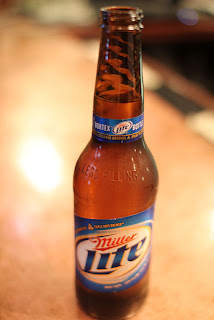
The Claim: The grooves in the bottle’s neck unlock that TRIPLE HOPS BREWED great Pilsner taste!

Why it’s B.S.: Like the Triple Hops Brewed gimmick, Miller Lite doesn’t really say exactly what the “vortex” created by the grooves is supposed to do. Is it supposed to release aromatics, like agitating a tulip glass? Miller Lite doesn’t have any aromatics, it's macro swill and it tastes exactly the same, no matter what time of the year or where you drink it. Ahhh..consistency, what I expect from factory food or drink! And even if it did have the slightest aroma, you’re usually drinking it straight out of the bottle, and right past your nose, do not pass go, do not collect $200. Basically, for the last few years industrial brewers have been trying to have us believe that we should buy their cheap beers because they’ve been making technological advancements in their bottles and cans?? That is just the stupidest thing ever. First there was the wide mouth can. That was actually sort of okay, believe me, you want to drink this stuff as fast as possible. Then it got absurd, enter the “vortex bottle”. Ok, they made bottles (some plastic) with spiraling grooves in the neck to enhance the way the beer is poured out of the bottle. Really? if there's one thing I can honestly say I NEVER had a problem getting out of the bottle, it's beer. Maybe I’d be into that idea for ketchup, or one of the other condiments that I wind up scraping out of the bottom of the jar with a butter knife, but never beer.
Absurd bottle, meet absurd commercial.
Clubber guy in sunglasses: I don’t see what’s so great about this bottle.
Half-naked waitress: It’s got grooves. Maybe if you take off your sunglasses, you’d see that.
Notice that, again, the waitress doesn’t explain what the grooves are supposed to do. I like to think that Clubber Guy in Sunglasses is actually a beer geek, dragged to a shitty club with his friends, and was actually asking what the grooves do expecting a coherent answer. Receiving nothing but idiocy and insults to his masculinity, he withdraws into the sounds of Corey Hart..IIIIII WEAR MY SUNGLASSES AT NIGHT SOOO IIII CANNN SOOO I CANNNSEE...probably to distract anyone from the real so-called purpose of the commercial, the vortex bottle.

The Gimmick: Frost Brewed Coors Light!


The Claim: It’s frost brewed so it’s as cold as the Rockies!

Why it’s B.S.: “Hmm. Well, we can’t think of a single good thing to say about our beer’s taste or aroma.....soooo...ummmm... Wait! I know! It’s cold! ” Coors Light’s entire marketing campaign is based on the fact that their beer is colder than everybody elses. Their cans have the mountains that turn blue so you can see when the beer is cold! And while I'm no self-proclaimed expert on cold, when deciding which sense to use to determine if something’s cold, touch has a pretty darn good track record. Moving right along, what exactly does “frost brewed” mean, anyway? Their water starts out colder than everyone else because it's in the Rockies? Well that doesn’t really matter since you have to eventually boil the water to make most of beer anyway. So just being technical, maybe frost brewed means it’s in near-freezing temperatures when it’s fermenting? But, frost-fermented just doesn't sound as good? Well if that’s what they're getting at, it's just lagering then, nothing special- that’s just how that particular style of beer is made by anyone who lagers beer. Finally, one of your first beer geek lessons in life is that you don’t want your beer to be too cold anyway. Especially with stronger and darker styles, more flavors come out as the beer warms. On top of that, cold beer numbs your taste buds. Wait, I might be on to something..nahh..I’ll give Coors the benefit of the doubt and believe that’s not what they’re striving for here.

The Gimmick: Beechwood-aged Budweiser!

The Claim: Budweiser’s award-winning flavor is attributed to the beechwood aging process!
Why it’s B.S.: Okay, while I'll admit Budweiser is not as quite as guilty here as the light beers above, they're still taking a page from the craft beer movement. If you dig around their website a little, they actually explain what they do with beechwood; and it’s not aging at all, it's simply that they boil beechwood chips to remove any traces of wood flavor, then put them in the fermenter to speed up the process a bit. Gives the yeast more surface area to work with. It’s a mighty fine process that I've actually seen first hand at Busch Gardens, but Budweiser’s being a bit crafty (hehe)here. Now that craft beer is headlining the beer market concert, our buds at BUD suddenly break out their old “beechwood aged” advertisements which were retired for quite a few years after BUD completely redesigned their marketing strategy. This term immediately evokes images of beer aging for months in WOOD barrels to anyone remotely familiar with aging ales in cask, which of course, is gaining a huge following in the craft beer community. GENIUS! Oh, wait, that's a Guiness ad and a story for another time.

Monday, August 22, 2011

Yukon Gold


My goal(d) here was to craft an easy drinking beer with a bit more of a taste profile than your standard macro-swill in the 3.5-4% range, soooo Yukon Gold was born. The color resembles an Amstel Light, the taste should blow it away. We'll know in three weeks as the small grain bill and low gravity will yield me a quick turnaround time from grain to glass.

Batch Size: 5.50 gal
Boil Size: 7.5.00 gal
Estimated OG: 1.034 SG
Estimated Color: 3.6 SRM
Estimated IBU: 17.0 IBU
Brewhouse Efficiency: 72.0 %
Boil Time: 90 Minutes
Ingredients:
0.50 lb Rice Hulls (0.0 SRM)
6 lb Pilsner (2 Row) Ger (2.0 SRM)
.75 lb Rye Malt (4.7 SRM)
.50 lb Caramel/Crystal Malt - 10L (10.0 SRM)
0.25 lb Cara-Pils/Dextrine (2.0 SRM)

.5 oz Sterling [7.50%] (90 min) (FWH)
.5 oz Sterling [7.50%] (5 min)

0.375 oz Coriander Seed (Boil 10.0 min)
0.375 oz Orange Peel, Bitter (Boil 10.0 min)
1.00 tsp Black Pepper Corn (Boil 10.0 min)

Safale-05 American Yeast
Mash in 3 gallons 160 degree water for 75 minutes, target 152
Mash out with 1.75 180 degree water
Sparge with 3.25 170 degree water
FWH with ½ oz sterling
Boil 90 min
Flavoring @ 10 min
Wort chiller @ 10 min
.50 Sterling @ 5 min
Cool to 70
Pitch yeast
Ferment @ 65 degrees for 14 days take a gravity reading
Crash cool @ 40 for 5 days
bottle
I mashed in a bit low, not really sure what happened since the temps in the basement are the warmest of the year. I mashed in at 8:40am and the temp at 8:57 was 148.
Mash out 9:55
Sparge 10:10
FWH 10:45
mow lawn
Add flavorings 12:05pm
final hops 12:10
cool to 70 12:15, gave up at 12:45, was wasting water and not dropping below 80
placed in converted freezer at 65 degrees and pitched yeast at 1:30pm
OG 1.039, nice efficiency
I left for Vermont for a few days and returned to this:


Sunday, August 7, 2011

TMSRCM Project


If I'd never met Terri Hall, Team Leader in Specialty at Whole Foods Market Marlton, NJ, I'd probably still be eating Cabot 50% light pseudo cheddar cheese with crackers as my sole source of cheese indulgence. Today, I'm an equal opportunity cheese monger—fresh, soft, hard, nutty, creamy, barn yardy, stinky, mushroomy, grassy, buttery, tangy, you name it, I'll try it. And as much as I dig tasting and talking feta, blue, and cheddar, I'd never thought about actually making my own other than some quick curd ricotta on the kitchen stove.

That is, until I met Linda and Larry Faillace of Three Shepherds Farm in Warren, Vt. Linda and Larry have taught the techniques, philosophy, and gastronomic delight of artisanal cheesemaking to more than 1000 students from North America, Scotland, Ireland, Columbia, Pakistan, Kuwait, India, and the Middle East. After three intense days in their cheese-making room, I had visions of my own small cheese business. I wondered aloud to my wife if my dog would mind sharing the backyard with my newly acquired dairy goats. I even talked about how we would convert the basement into a cheese cave for aging my soon-to-be award winning farmhouse Gouda by hacking through the concrete foundation to the 55'ish degree earth on the other side.

Filled with enthusiasm, I bought gallon upon gallon of organic milk, put a small gas stove in the basement, and threw myself into the process. I quickly realized that my dream business had one major drawback: Real cheese making is wicked tough and takes dedication as well as an understanding that it's not a static process or exact science that is easily replicated time after time. Companies like McDonalds spend millions of dollars annually ensuring that their products taste exactly the same wherever they are sold across the country, because that is what the consumer expects when they enter a McDonalds-consistency. Multiple distributors are charged the task of matching each others taste profiles from everything like buns, to pickles, to condiments. BORING! Cheese? Not going to happen on a small scale as factors such as pH, humidity, moisture, salt, temperature, curd size and drain rate (time) all play a significant factor in the taste of the final product. There's a lot of chemistry to ponder; some seriously intense temperature monitoring and note taking, and a ton of patience needed before you can slap an edible end result to milk chemistry in motion.

Of course, I also had some early success. My third batch of comparably easy-to-make ricotta was spot-on smooth, with just a hint of residual sweetness. My second attempt at mozzarella using raw milk and a self learned short cut, yielded a firm and milky-tasting product that fared well in a Caprese salad and melted beautifully on a grilled tomato and cheese sandwich. Not-so-rella was born! Today, I have high hopes for my soft ripened cow's milk cheese that I recently debuted with team members at Whole Foods.

This creation, drained and aged for a short time the confines of my basement, basically yields three VERY edible cheeses from one gallon of Whole Foods 365 Organic Whole Milk, utilizing 4 basic ingredients; milk, starter culture, citric acid and calf rennet.

The first cheese, a soft ripened cow's milk cheese with Italian herbs that drained in a ricotta basket is silky smooth and mild, and that same cheese (the second cheese) drained in heart-shaped molds with smaller draining holes yields a much more tangy, soft-ripened cheese that mimics a fresh chevre. The third cheese, Quark(in the bag), is a simple yet very versatile cheese that I whipped and then combined with cherry preserves for a decadent, yet light dessert.


I shared the two soft-ripened cheeses with numerous team members from Whole Foods, Marlton. Once the votes were tallied, it was almost dead even, with the younger demographic opting for the tangy rendition and the more mature folk giving the nod to the milder counter part. My goal here was multi-faceted. First, I wanted to receive objective opinions on the cheese from people.(I told numerous team members that it was a new cheese that we had just received in Specialty, not mentioning anything about being made in my basement). Second, I wanted to utilize the feedback in determining whether or not I should move forward in an attempt to someday market this cheese as a "team member" made cheese at Whole Foods.


Overall, the feedback was super positive and leaves me yearning to learn more about this type of cheese and how to improve and refine the process for larger batch production. I have enrolled in a french cheese making class at Three Shepherds in Vermont the third weekend in August where a good portion of the class will be spent making softer cheeses with similar profiles to the one I would like to eventually make and sell at the retail level.