Labels

Showing posts with label Cheese. Show all posts

Monday, July 1, 2013

Taleggio Pairing


Taleggio is one of those cheeses whose name even a novice turophile would recognize. Many people associate it with being a very stinky cheese when in fact, on the stink level, it's pretty mellow. It gets its name for the Valtaleggio region in northern Italy, near Lombardy. It is characteristically aromatic yet mild in flavor and features tangy, meaty notes with a fruity finish. The texture of the cheese is moist almost jello-like with a very pleasant melt-in-the-mouth feel. The combination of the soft texture, pungent aroma, and buttery flavors has proven to be addictive especially when spread on fresh crusty bread. 
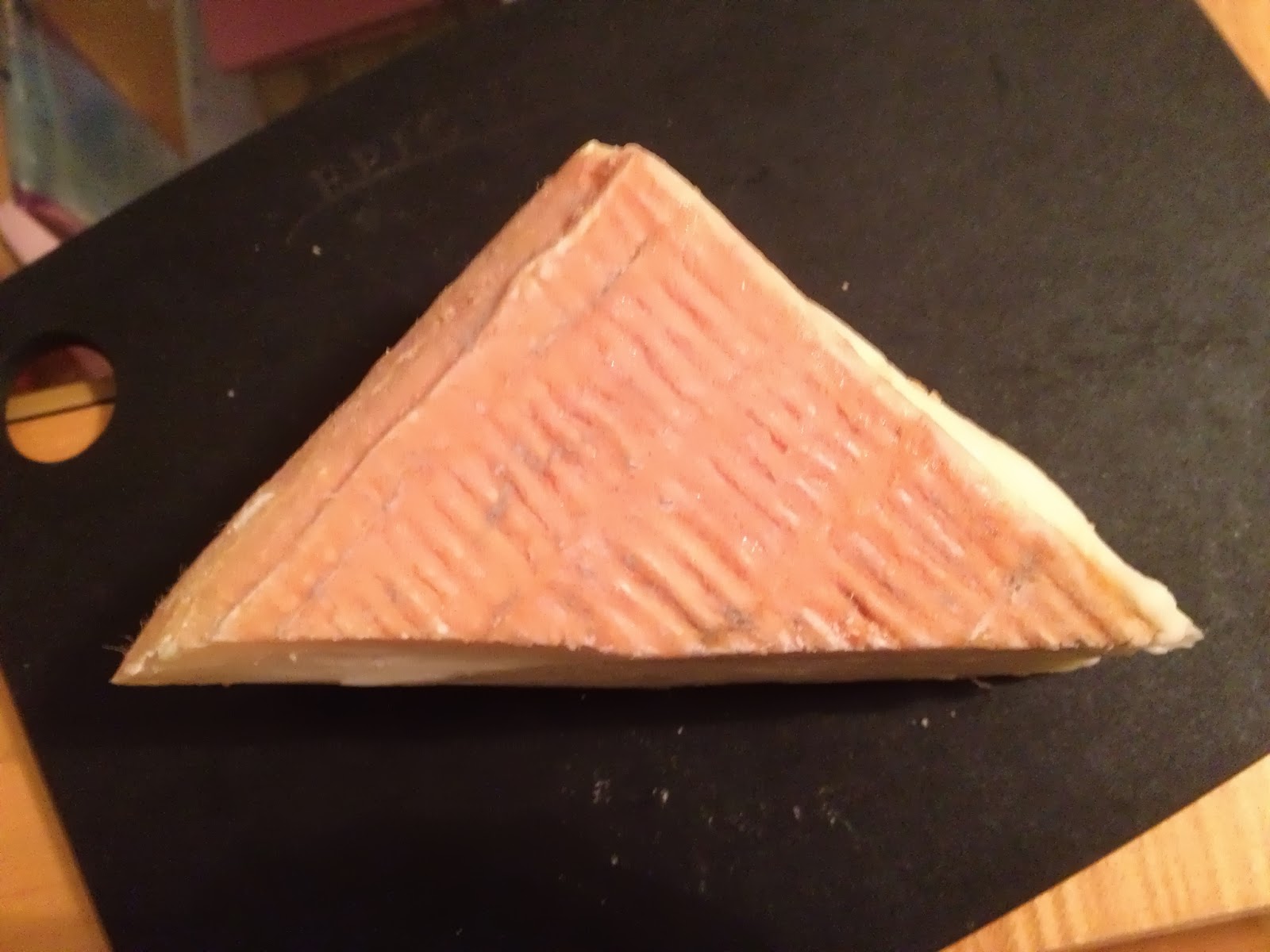
You can see that the rind has a bit of a reddish hue and that tells us that this is a smear ripened cheese similar to an Epoisses or Grayson. When the cheese is being made, the curds are put into molds and then left at temperatures of around 70-77 degrees F. From there they are brined or hand salted and aged in caves for about 40 days. During the aging process, they are cleaned with a salt water solution to keep any unwanted molds away and to help develop the sticky, reddish rind that have beome so popular in today's cheese circles.

The texture of this cheese is like a dense marshmallow. It is pale cream in color and is springy, yet wonderfully smooth. The scent is super grassy and not too stinky. I don't typically eat the rind on this cheese because it is a bit bitter, but the paste of the cheese is so creamy and unctuous, sweet and mushroomy all at the same time. The pasteurized version tends to be a bit more mellow than the raw version as the raw milk keeps a lot of the natural flavors which shine through beautifully.


This cheese pairs wonderfully with a fruity, effervescent, Saison like Great Divide's Colette or Surly's
Cynic.

Saturday, May 18, 2013

Moses Sleeper and The Prince


Moses Sleeper is a luscious bloomy rind named after historical figure in the Greensboro area of Vermont. Moses Sleeper was killed in 1871 along with Constant Bliss (another cheese by Jasper Hill that resembles Charouce, but is no longer in production) while guarding the trail that led to the area of Vermont near what is now the Jasper Hill farm and creamery.  Moses Sleeper, just recently released, is a bloomy rind cheese made from pasteurized cows milk. Like all Jasper Hill Farm cheeses, that milk is produced by a small herd of Ayrshire cows which graze seasonally on the farm’s pastures. Those pastures have been developed by herdsman Andy Kehler, and the excellent milk stays on the farm where it is converted to cheese by a team led by Andy’s brother Mateo. Moses Sleeper is compared to French styles like Reblochon and Camembert. The cheese matures for about 40 to 60 days and it develops a thin pliable white rind with some pink patches. The paste develops very small eyes or holes. The flavor should be mild, with notes of fresh milk when it is released, gaining complexity as it ages further.

The cheese: Paste was ivory and shiny, with the impression of small to medium eye holes in the ooze. From the rind and paste there was an earthy aroma, mushroom, some asparagus. On taste, definitely asparagus notes up front, and fresh cream on the finish. The mouthfeel was soft and silky, like melting chocolate punctuated by chewy bits of rind. Some bitterness on the rind, but nothing off-putting. The overall impression I kept getting was of a nicely-made cream of asparagus soup. Most reviews note the clean freshness of this cheese, but keep in mind that mine was a bit further into the ripeness curve. I loved the complex vegetal flavors, but I would also love to compare it to a younger Moses (that doesn't sound right).

The Beer: The Prince, my Tripel, brewed on April 13th and just carbonating now,  pours a deep golden-amber with a white, fluffy head that falls quickly to a compact ¼-inch cap. It’s bright and clear with columns of tiny bubbles ascending. The aroma is sweet like cotton candy-really and that's exactly how my 4 year old described it (smells like candy daddy). The flavor attack is slightly bitter, sweet and alcoholic (phenolic). Very much what one would expect of a Belgian style Tripel with maybe a hint of "harsh", but the beer is very young and I plan to celler it for months. The mouthfeel is perfect, with a fairly light body, and an effervesent carbonation (it has only been in the bottle 6 days, so it should continue to carbonate over the next week or two to about 3.3 volumes CO2 per the style.

Beer Plus Cheese: These two play off each other well, but they keep a bit of a distance. They are well matched in terms of intensity — the ripeness of my piece of Moses may have helped here. Two very nice, bold flavor packages. In your mouth together the asparagus soup theme continues, with an overlay of exploding bitterness and alcohol esters. This is a nice, if not completely harmonious pairing. The sweet, high octane flavor of the beer and the rich vegetable and cream flavors in the cheese don’t quite wrap around each other enough to be a perfect pair, but instead seem to stand together nicely.

Friday, March 22, 2013

Herve Mons Ovalie Cendree


Are you a Herve Mons fan? You will be after trying Ovalie Cendree. This long oval shaped cheese exhibits classic milky ovaltones( yeah, I went there), grassiness and citrus abound but with warm earthy attributes and hints of mushroom on the rind. Ovalie Cendree has the most unique depth to it and pairs wonderfully with artisan crusty bread and fruit.

Saturday, March 9, 2013

Parmageddon 2013


Arguably the greatest dairy product produced on the face of the earth, practically unchanged for over 700 years.

Parmigiano Reggiano has been documented to have been in existence as early as the 13th century. This is no laughing matter. There is nothing remotely laughable about this cheese. I use the term "cheese" for lack of a better word. It is quite possibly the greatest dairy product produced on the face of the earth and it has been practically unchanged for over 800 years.

Have you ever tried it? Have you ever experienced its delicacy or its nutty and slightly salient complexity? Were you aware that the swine raised to become prosciutto di Parma humbly nosh on the residual whey from the course of production of Parmigiano-Reggiano? And, did you know the consumption of this whey enhance the hams’s own flavor? Is it a coincidence that two of the most outstanding ingredients in gastronomy are interdependent on the same process? Probably not. And, is it fate that both these culinary operas derive from the same place on earth? Well, I am not completely confident fate exists, but it is fortuitous.

Still, there is a loop-hole. Look in your refrigerator. You might have an impostor, worthy of mocking. It is called parmesan (notice I did not capitalize it). Parmesan, I learned is a borrowed word from French that means Parmigiano. Parmigiano in Italian indicates something from Parma. In America, parmesan has become the generic term for cheeses that mimic the flavor of Parmigiano-Reggiano. These imitations are garbage. Sorry Kraft, nice try! We can make fun of them all we want. In the future, I might go on a blogging tirade about parmesan cheese, but we have more important issues at hand, and it's PARMAGEDDON. That's right, the end of the world record as we know it. This Saturday at 3:00pm EST Whole Foods Markets around the United States, Canada and the UK will attempt to simultaneously "crack" 500 wheels of authentic 2-year aged Pamigiano Reggiano. What will you be doing his Saturday afternoon? Shouldn't you be witnessing this historic event while scarfing down copious amounts of free Parmigiano Reggiano?

And I’m not trying to single out Kraft – I love their processed American Singles on burgers (as I recall this used to be called “American cheese food” because it couldn’t actually be labeled as “cheese,” but today they seem to dispense with the word cheese altogether). In fact, in terms of consumer confusion Kraft probably plays a very small role, since its ubiquitous dry powdered “cheese” in green cardboard tubes is so far removed from actual Parmigiano-Reggiano that virtually no one could confuse the two. In fact, an exhibit on imitation cheeses from other countries fills an entire room at the Parmigiano-Reggiano museum just outside of Parma, Italy. That's right, I said museum- a museum dedicated to a single recipe for cheese. The much bigger problem are the wedges of faux Parmigiano-Reggiano cheeses sold even at higher end supermarkets, gourmet stores, cheese specific shops and the high-priced national retailers purporting sell purer, better-for-you foods. Many of these imitators are produced here in the U.S. or South America, especially Argentina, and come with names such as Parmesan, Parmigiana, Parmesana, Parmabon, Real Parma, Parmezan, Parmezano and my all-time favorite, Permesansan (really). But most of the faux Parmigiano-Reggiano you will find here in the States is called simply Parmesan, and anyone who doubts for a second that its manufacturers are trading on the good name of the real stuff only has to consider that the 800 year old Parmigiano-Reggiano is named for its birthplace, Parma, an actual city.