California Common is a New World beer style. In fact it is one of two classic styles that everybody agrees are genuinely American, the other being cream ale. California Common is an odd beer, essentially a lager that tastes more like an ale. Some people call it a hybrid beer; others are less genteel and call it a bastard. It is a quaffing brew for the common man and woman, a brew reminiscent of the rough and tumble days of the Alaska Gold Rush of the 1890s, when many of the mostly male inhabitants of San Francisco lined up on the docks waiting to be transported to the riches of the northern frontier.
Obviously, in those days before the Panama Canal, there was hardly enough “imported” beer available to satisfy the collective thirst of the disparate lot of prospectors, thrown together from all corners of the country, even the globe. Not surprisingly, enterprising publicans quickly filled the void by brewing their own beer on location, and because German immigrant brewers used to dominate American brewing, including California brewing, at the time, the brews these California pioneer brewers made were lagers . . . but lagers with a difference.
California Common, a can-do and make-do style
Before man acquired the technology to control the entire brewing process as well as the transportation network to make locales irrelevant, he could only make the beers nature allowed him to brew, and do so with local materials. In the cold winters of Munich, for instance, near the foothills of the Alps, lager emerged, because only bottom-fermenting yeasts can work in such a climate. The Rhineland, by contrast, never got cold enough for lager brewing nor warm enough for ale brewing by the British way. The result was the cool-fermented Altbier and its blond cousin, the Kölsch. In the British Isles, on the other hand, warm-fermenting brews thrived, which resulted in a cornucopia of ale styles from the blondest pale ale to the darkest stout.
In far-away California, however, it was much warmer and the brew equipment was primitive. According to the Anchor Brewing Company Website, the California brew scene was run mostly by German-born entrepreneurs in the 19th century. They had such names as Behlmer, Böse, Freyer, Garms, Hage-mann, Hansen, Lurmann, Schleemann, Schröder, Schwarz, Thode, Veen, Win-deler and Wunder. True to the tradition of their native land, they used lager yeast, probably hauled in from the Eastern seaboard. As for grain and hops, they probably used whatever happened to become available on the local market. From these ingredients, they made their beers in flat open fermenters. Even after the invention of refrigerated beer vats in Munich in the 1870s, such technologies were not yet available in the pioneer outposts at the Golden Bay.
Whichever lager yeast these early brewers might have used initially, it is likely that it mutated rapidly in the unusual, non-lager-like environment. Not surprisingly, the character of the San Francisco brews began to reflect the character of their times and circumstances. The result was a beer, which, though bottom-fermented, tasted more like an ale, probably with plenty of fruitiness and butter-scotch flavor.
Initially this brew from the steamy shores of San Francisco was called “steam beer.” It is not clear where the name came from, but according to one fanciful theory, the cask-conditioned California brews of the 1890s gave off plumes of “steam” when their bung holes were opened prior to tapping. Another theory suggests that the name relates to the early steam engines installed in some California breweries. As these steam-equipped breweries proudly bragged about their modern machinery in their promotions, their brews came to be known as “steam beer.”
Whichever is the true explanation, for legal reasons, the descendants of these beers are now universally called California Common, because “Steam” has since become a trademark owned by the Anchor Brewing Company of San Francisco. The steam beer style had nearly faded into oblivion by the 1960s. Fewer and fewer breweries bothered to make it, while generic mass lagers were capturing an ever-increasing market share. It was then that Fritz Maytag purchased one of the last steam breweries — namely Anchor. This brewery was founded in the 1850s by two German immigrants. In 1896, it had fallen into the hands of two German-born steam brewers, Otto Schinkel and Ernst Baruth. After several changes in ownership, Fritz Maytag acquired the brewery in 1965, just before it was to be closed down, and he turned it into one of the biggest success stories of the American craft brew revival.
Not a difficult beer too brew if you have a temperature controlled environment:
Grist:
9lbs 2-Row malt
1lb Crystal 20l (should be 60l, see Simple Pale Ale
1lb Munich mALT
Hops:
1oz Northern Brewer 60min
.5oz Northern Brewer 15min
.5oz Northern Brewer 5min
1oz Northern Brewer 1min
Yeast:
Wyeast California Lager
Target OG 1.048 Actual OG 1.051
Ferment 2 weeks at 60 degrees and one month at 50 degrees
Crash cool to 40 for one week, then I kegged the beer.
This was outstanding and amazingly clear by Christmas.
Sunday, November 10, 2013

Saturday, November 9, 2013
For Starters
This beer is based on one of the rarest beers in the world, brewed in the Belgian town Malle solely for consumption by the reverent Cistercian brothers. This ale is not served or sold to the public. Made only from pilsner malt, hops, and yeast, the complexity that results from these simple ingredients is staggering: perfumey floral hops, ripe pear fruit, sour apple, spicy cloves, candied citrus and a slight biscuit character on the drying finish ... a monks’ session beer.
Grist:
9lbs Belgian Pilsner malt
Hops:
1oz Tradition 60min
.5oz Saaz 60min
.5oz Saaz 10 min
Yeast:
Wyeast #3787 Trappist High Gravity
The yeastcake for this beer will also provide the starter for #10 in December, a traditional Trappist Ale to be cellared for one or more years. (Of course there will be test bottles too:))
Mashed in 4.3 gallons of 158 degree water, no mash out, target 147
Sparged with 3.5 gallons 185 degree water
Boil time was 75 minute to adjust for volume
Target OG 1.047
Actual OG 1.049
Update: I mashed this beer very low and the result is a very dry, highly drinkable Belgian single with hints of clove and pronounced fruitiness from the yeast. Bottle date was 12/8, brew date for #10 was 12/9.
Grist:
9lbs Belgian Pilsner malt
Hops:
1oz Tradition 60min
.5oz Saaz 60min
.5oz Saaz 10 min
Yeast:
Wyeast #3787 Trappist High Gravity
The yeastcake for this beer will also provide the starter for #10 in December, a traditional Trappist Ale to be cellared for one or more years. (Of course there will be test bottles too:))
Mashed in 4.3 gallons of 158 degree water, no mash out, target 147
Sparged with 3.5 gallons 185 degree water
Boil time was 75 minute to adjust for volume
Target OG 1.047
Actual OG 1.049
Update: I mashed this beer very low and the result is a very dry, highly drinkable Belgian single with hints of clove and pronounced fruitiness from the yeast. Bottle date was 12/8, brew date for #10 was 12/9.
Sunday, October 13, 2013
Rusty Pale Ale-Take Two
The first mistake turned out wonderful, so I changed up the hops a bit and did it again.
8lb 2-row
2lb vienna
.75 crystal 60l
.25 cent .25 chinook 60
.25 cent .25 chinook 30
.25 cent .25 chinook 15
.20 chinook .20 citra .20 simcoe .10 cent 0 min
s-05
OG 1.050
dry hopped this with .80 cascade...
8lb 2-row
2lb vienna
.75 crystal 60l
.25 cent .25 chinook 60
.25 cent .25 chinook 30
.25 cent .25 chinook 15
.20 chinook .20 citra .20 simcoe .10 cent 0 min
s-05
OG 1.050
dry hopped this with .80 cascade...
Thursday, September 26, 2013
Simple Pale Ale
Rusty after not brewing all summer...rusty in color because being rusty caused me to add crystal 40l that was slated for my common denominator by accident, giving me a slightly darker "pale" ale.
Recipe Type: All Grain
Yeast: S-05
Yeast Starter: Nope
Additional Yeast or Yeast Starter: Nope
Batch Size (Gallons): 5.5
Original Gravity: 1.051
Final Gravity: 1.011
IBU: 39
Boiling Time (Minutes): 60
Color: 10 SRM
Primary Fermentation (# of Days & Temp): 10 Days at 68 degrees
Grain Bill
8 lbs. 2-Row Pale Malt
2 lbs. Vienna Malt
0.5 lb. Crystal 20L Malt
Mash
Single Infusion mash for 60 minutes at 152 degrees.
Dough-in with 3.5 gallons of water. After 60 minutes, add 5 quarts of 175 degree water and begin vorlauf. My system only takes about 2 quarts before it clears up, then it's wide open to drain in the kettle. Have another 3.25 gallons of 175 degree water ready for the next batch sparge. You should then get 6.5 gallons to your kettle for the boil.
Boil & Hops
1.0 oz Cascade 6.6% at 60 min.
0.5 oz. Cascade 6.6% at 30 min.
0.25 oz. Cascade 6.6% at 15 min.
0.25 oz. Cascade 6.6% at 5 min.
0.25 oz Simcoe at 0 min
Chill to 70 to 75 degrees
Ferment at 60-64 ambient.
Brew Date 09.26.13
Recipe Type: All Grain
Yeast: S-05
Yeast Starter: Nope
Additional Yeast or Yeast Starter: Nope
Batch Size (Gallons): 5.5
Original Gravity: 1.051
Final Gravity: 1.011
IBU: 39
Boiling Time (Minutes): 60
Color: 10 SRM
Primary Fermentation (# of Days & Temp): 10 Days at 68 degrees
Grain Bill
8 lbs. 2-Row Pale Malt
2 lbs. Vienna Malt
0.5 lb. Crystal 20L Malt
Mash
Single Infusion mash for 60 minutes at 152 degrees.
Dough-in with 3.5 gallons of water. After 60 minutes, add 5 quarts of 175 degree water and begin vorlauf. My system only takes about 2 quarts before it clears up, then it's wide open to drain in the kettle. Have another 3.25 gallons of 175 degree water ready for the next batch sparge. You should then get 6.5 gallons to your kettle for the boil.
Boil & Hops
1.0 oz Cascade 6.6% at 60 min.
0.5 oz. Cascade 6.6% at 30 min.
0.25 oz. Cascade 6.6% at 15 min.
0.25 oz. Cascade 6.6% at 5 min.
0.25 oz Simcoe at 0 min
Chill to 70 to 75 degrees
Ferment at 60-64 ambient.
Brew Date 09.26.13
Wednesday, September 18, 2013
Bacon Fig Jam
Same basic recipe of the marmaljam, with a few tweaks. I was prepared for the amount of time it was going to take to reduce this go around and even made a pizza in the interim.
Ingredients:
12 or so figs cut into quarters
1 1/4 cup granulated sugar
1 tablespoon raw honey, cinnamon
1 teaspoon sweet orange peel
6-7 pieces cooked bacon
1 1/2 cups water
1/2 lemon
Bring water to just about boiling
add figs, simmer until tender
add sugar and honey
reduce by half
add orange peel and bacon (crumbled)
reduce until it begins to thicken
add juice of 1/2 lemon
stir and reduce until jam begins to adhere to spoon-reduce another 15 minutes
cool
chill


Ingredients:
12 or so figs cut into quarters
1 1/4 cup granulated sugar
1 tablespoon raw honey, cinnamon
1 teaspoon sweet orange peel
6-7 pieces cooked bacon
1 1/2 cups water
1/2 lemon
Bring water to just about boiling
add figs, simmer until tender
add sugar and honey
reduce by half
add orange peel and bacon (crumbled)
reduce until it begins to thicken
add juice of 1/2 lemon
stir and reduce until jam begins to adhere to spoon-reduce another 15 minutes
cool
chill


Thursday, September 12, 2013
Orange Cinnamon Fig Marmaljam
I had a great fig harvest this year, over 100 and they are still coming. I decided to try my hand at a marmalade. Everything I read about a marmalade involves precise temps for setting the mush as well as copious amounts of pectin. Lots of trial and error on the marmalade boards and lots of disappointing, runny, end results. Since I'm not one to ever follow recipes to the "T", I adapted several recipes into a pseudo jam and utilized some left over brewing adjuncts from seasonal beers. I'm going to be honest, it took a while to render that sucker down, a lot longer than I thought it would (stupid me for starting at 9pm when I had to work at 5am the next day), but the end result was spot on. I'm going to use this in a bacon, fig, marmaljam grilled cheese tomorrow, but here's the recipe in the interim.
Marmaljam(not quite marmalade, not quite jam):
12 or so figs (some were very overripe(can you say shrinkage?), some were perfect) cut into quarters
1 1/4 cup granulated sugar
1 tablespoon raw honey (seriously, only because wanted to get rid of it, I scraped the jar)
1/4 oz sweet orange peel (leftover from brewing)This too can be potent and if you don't want the orange to co-star with the fig, taper it back to an 1/8oz.
1 cinnamon stick (left over from last year's christmas ale)
2 cups water
1 1/4 cup sugar in the raw
1/2 lemon
Bring water to just about boiling in a large NON-STICK saucepan (I used my scan pan wok, I love this utensil and cook everything in it. pasta never boils over, no matter how high, burgers, rice, veggies, you name it)
Add the fig quarters and turn down to medium
Stir and stir until tender, giving a slight mash with a wooden spoon
Add the sugar and stir some more, gently, until dissolved, bring to a simmer
Add the sweet orange peel
Add the raw honey
let it render down until it darkens and add the cinnamon stick
(I took the cinnamon stick out several times and tasted, my stick was old, but it's very powerful stuff, don't overdo it and remember that it's going to be concentrated)
Simmer and stir, and stir and stir, until midnight, even if you have to get up at 4am
As it begins to render down and thicken, add the juice of the 1/2 lemon, pick out any seeds)
Once you get to a consistency that holds a bit on the spoon, let it go 15 more minutes (seriously, this was a total guess)
Remove from heat and let cool (it will thicken even more) and put it into jars or a bowl with a lid (you aren't making enough to bother canning)
Go to bed at 12:30am
Get up at 4:00am and rejoice at the consistency, put it in the fridge and hope it doesn't harden like candy and go to work
Crazy good on bread with some peanut butter, can't wait for the grilled cheese!
Cheers!!


Marmaljam(not quite marmalade, not quite jam):
12 or so figs (some were very overripe(can you say shrinkage?), some were perfect) cut into quarters
1 1/4 cup granulated sugar
1 tablespoon raw honey (seriously, only because wanted to get rid of it, I scraped the jar)
1/4 oz sweet orange peel (leftover from brewing)This too can be potent and if you don't want the orange to co-star with the fig, taper it back to an 1/8oz.
1 cinnamon stick (left over from last year's christmas ale)
2 cups water
1 1/4 cup sugar in the raw
1/2 lemon
Bring water to just about boiling in a large NON-STICK saucepan (I used my scan pan wok, I love this utensil and cook everything in it. pasta never boils over, no matter how high, burgers, rice, veggies, you name it)
Add the fig quarters and turn down to medium
Stir and stir until tender, giving a slight mash with a wooden spoon
Add the sugar and stir some more, gently, until dissolved, bring to a simmer
Add the sweet orange peel
Add the raw honey
let it render down until it darkens and add the cinnamon stick
(I took the cinnamon stick out several times and tasted, my stick was old, but it's very powerful stuff, don't overdo it and remember that it's going to be concentrated)
Simmer and stir, and stir and stir, until midnight, even if you have to get up at 4am
As it begins to render down and thicken, add the juice of the 1/2 lemon, pick out any seeds)
Once you get to a consistency that holds a bit on the spoon, let it go 15 more minutes (seriously, this was a total guess)
Remove from heat and let cool (it will thicken even more) and put it into jars or a bowl with a lid (you aren't making enough to bother canning)
Go to bed at 12:30am
Get up at 4:00am and rejoice at the consistency, put it in the fridge and hope it doesn't harden like candy and go to work
Crazy good on bread with some peanut butter, can't wait for the grilled cheese!
Cheers!!


Monday, July 1, 2013
Taleggio Pairing

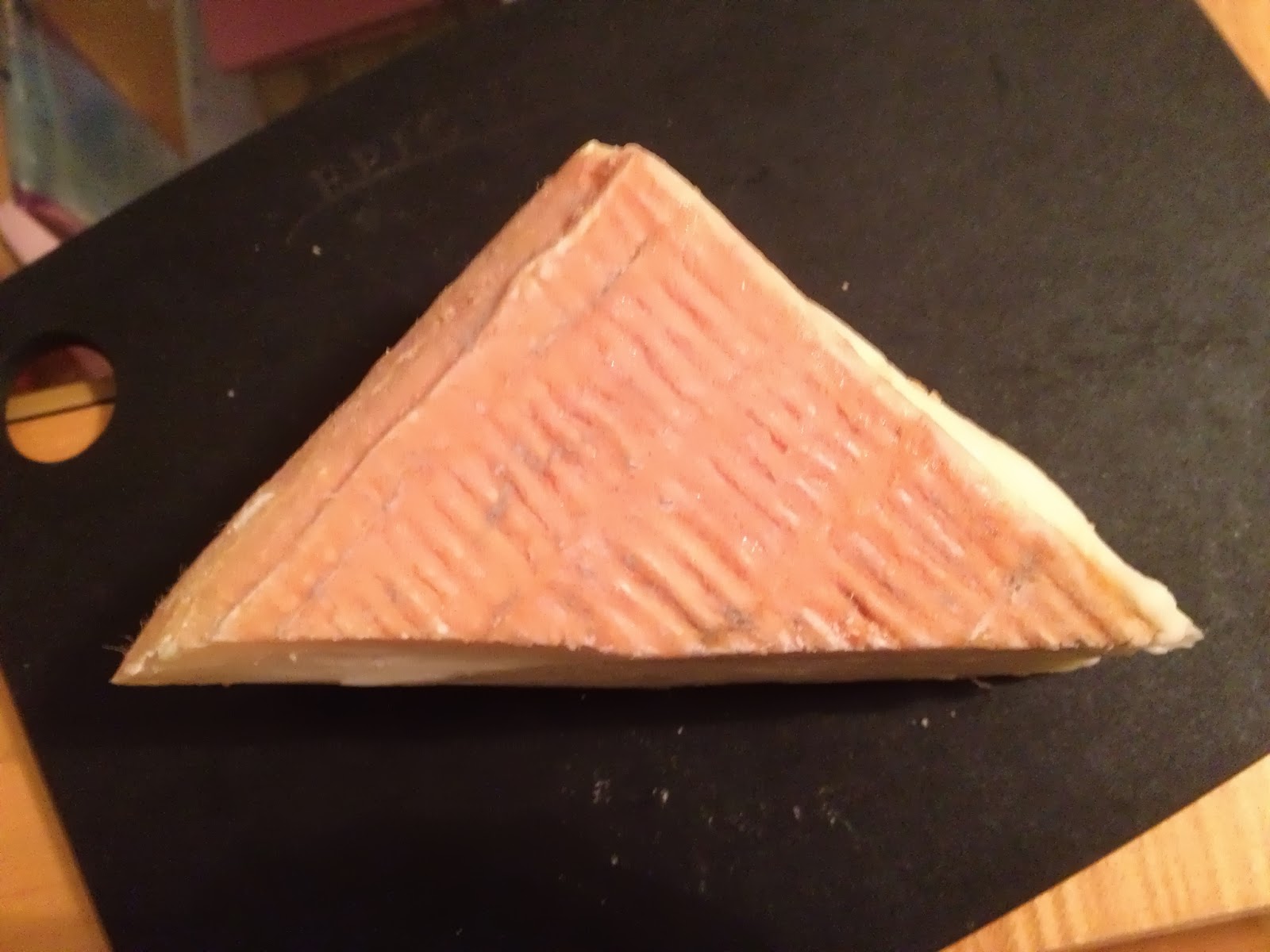
Taleggio is one of those cheeses whose name even a novice turophile would recognize. Many people associate it with being a very stinky cheese when in fact, on the stink level, it's pretty mellow. It gets its name for the Valtaleggio region in northern Italy, near Lombardy. It is characteristically aromatic yet mild in flavor and features tangy, meaty notes with a fruity finish. The texture of the cheese is moist almost jello-like with a very pleasant melt-in-the-mouth feel. The combination of the soft texture, pungent aroma, and buttery flavors has proven to be addictive especially when spread on fresh crusty bread.
You can see that the rind has a bit of a reddish hue and that tells us that this is a smear ripened cheese similar to an Epoisses or Grayson. When the cheese is being made, the curds are put into molds and then left at temperatures of around 70-77 degrees F. From there they are brined or hand salted and aged in caves for about 40 days. During the aging process, they are cleaned with a salt water solution to keep any unwanted molds away and to help develop the sticky, reddish rind that have beome so popular in today's cheese circles.
The texture of this cheese is like a dense marshmallow. It is pale cream in color and is springy, yet wonderfully smooth. The scent is super grassy and not too stinky. I don't typically eat the rind on this cheese because it is a bit bitter, but the paste of the cheese is so creamy and unctuous, sweet and mushroomy all at the same time. The pasteurized version tends to be a bit more mellow than the raw version as the raw milk keeps a lot of the natural flavors which shine through beautifully.
This cheese pairs wonderfully with a fruity, effervescent, Saison like Great Divide's Colette or Surly's
Cynic.
Subscribe to:
Posts (Atom)